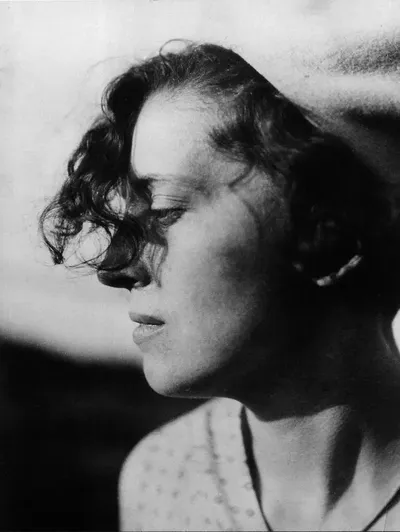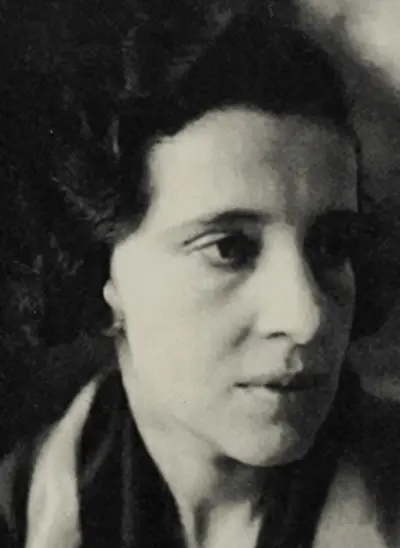

The art historian Lilli Fischel (1891–1978) was the first woman in Germany to head a state art gallery. Lilli Fischel was born Luise Fischel on January 14, 1891, in Bruchsal and was the youngest of four children. Her mother, Eugenie Fischel (née Theis), raised the children in the Protestant faith. Her father, Ottmar Fischel, was a Jewish manufacturer who produced high-quality kerosene lamps and held numerous patents. Lilli Fischel grew up in Bruchsal, where she attended elementary school.
High School and Academic Education
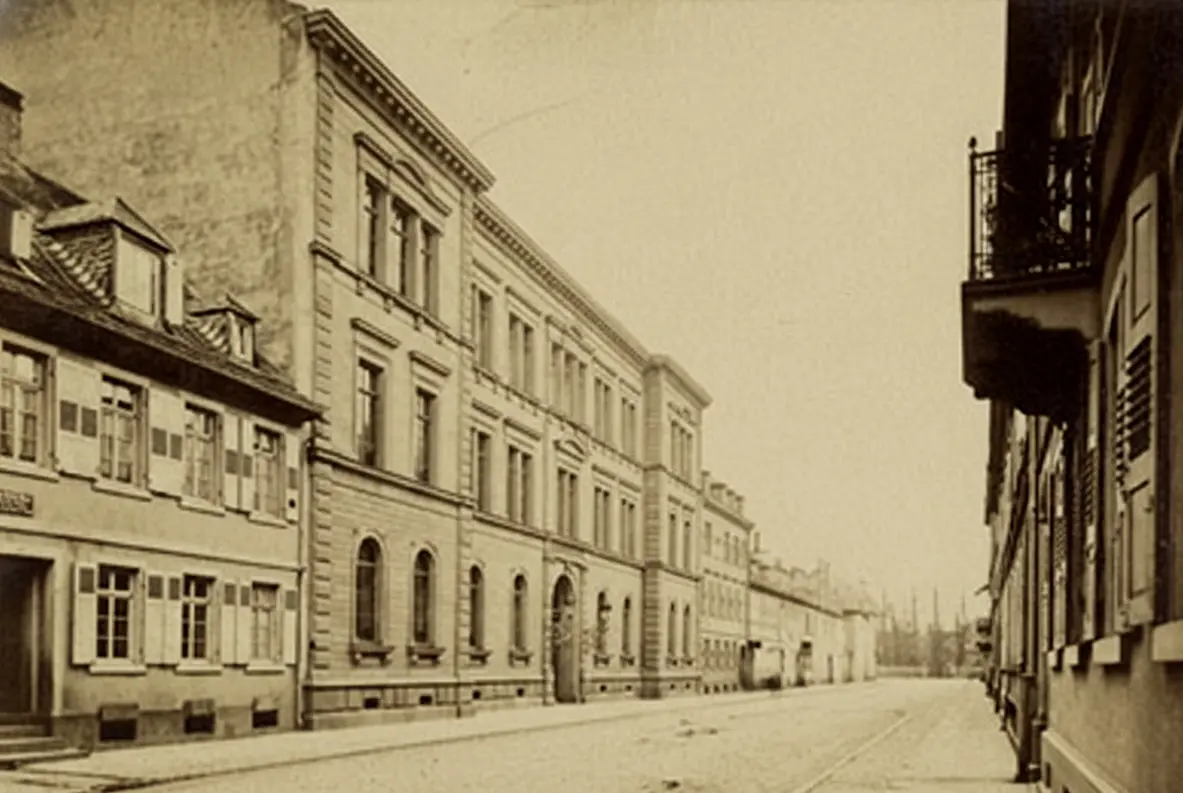
Starting in 1906, her family resided at Kaiserallee 24 in Karlsruhe. Lilli Fischel passed her Abitur in 1909 as an external student at the Humanistisches Gymnasium in Karlsruhe, today’s Bismarck-Gymnasium. Since the Humanistisches Gymnasium was an all-boys school at the time, it is highly probable that Lilli Fischel attended the girls' gymnasium on 14 Sophienstrasse starting in 1906. This school – today the Fichte Gymnasium – was at that time the only institution in Germany that specifically prepared girls for the Abitur (university entrance exam).
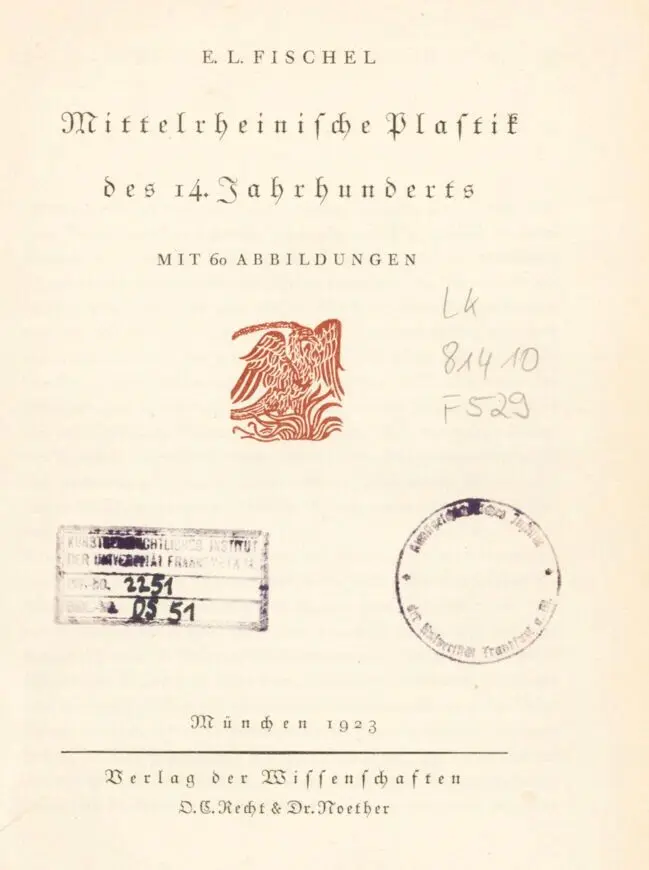
That same year, Lilli Fischel began her studies at the Academy of Fine Arts in Karlsruhe and continued her academic education in philosophy and art history at the universities of Munich and Freiburg. She completed her studies at the University of Frankfurt am Main, where she earned her doctorate in art history in 1919. The subject of her dissertation was "Mittelrheinische Plastik des 14. Jahrhunderts" (14th-Century Sculpture of the Middle Rhine). Additionally, she passed her oral examination in archaeology. She subsequently worked on the publication of her dissertation and, starting in 1923, spent two years working at Friedrich Sebald's art gallery at Waldstrasse 30 in Karlsruhe. As early as 1920, the gallery had showcased modern artists such as Rudolf Schlichter, Georg Scholz, and Wladimir von Zabotin.
Internship at the Badische Kunsthalle
In February 1925, Lilli Fischel applied for an internship at the Kunsthalle. At that time, she was friends with the assistant director, Dr. Hans Curjel, who likely encouraged her to submit an application. Curjel, who had also studied music, intended to leave the Kunsthalle for a position as a director at the Kroll Opera in Berlin. He possibly saw Lilli Fischel as his successor. Even in her letter of application, she pointed out that she did not wish to work without compensation and assumed that the position would be permanent and offer opportunities for advancement.
Lilli Fischel was approved for an initial salary of 236 RM per month. However, this marked the beginning of a permanent struggle for adequate compensation, during which she threatened to resign in several letters to the Ministry of Culture; she ultimately did not follow through out of consideration for the health of the director, who suffered from pulmonary tuberculosis. The director at the time was art historian Willy Storck, who had taken over the office from Hans Thoma in 1919 at the age of 30 and quickly faced criticism from Thoma's supporters due to his pursuit of new acquisition and exhibition concepts.
Appointment as Deputy Director
After Hans Curjel, left the Kunsthalle in 1927 and the director's health visibly deteriorated, Lilli Fischel was appointed assistant to the deputy director of the Kunsthalle, according to a file note dated August 8, 1927. However, it was noted that no formal appointment would take place. At that time, Lilli Fischel still held the status of a "scientific assistant" (wissenschaftliche Hilfsarbeiterin). Willy Storck, who quickly recognized Fischel's qualities, fought for her by all means and supported her demands with well-reasoned letters to the Ministry of Culture. After four years, Fischel's monthly salary was gradually increased to 584 RM. However, this was still approximately 40% below the salary that a head of the Kunsthalle appointed as director would have received.
When Storck passed away from pulmonary tuberculosis on August 30, 1927, at the age of only 38 after years of suffering, the position was advertised. In March 1928, Lilli Fischel was appointed curator (Kustodin), and in October 1928, she was promoted to conservator (Konservatorin). The search for a new director continued almost three years. It was not until May 1930 that the process was finally halted. Lilli Fischel was officially entrusted with the management of the Kunsthalle, yet she was not appointed director. This was an unusual occurrence, for which there were several reasons. While the fact that Lilli Fischel was a woman played a role, it was not the only reason why she was denied the appointment as director.
Search for a New Director
The reason the position could not be filled externally was due, first and foremost, to the Ministry of Culture’s inability to find a suitable candidate. There were plenty of applicants—23 in total—many of whom were well-known and respected. However, the ministry backed the wrong horses, and their overall approach demonstrated an astonishing lack of professionalism on the part of the responsible officials.
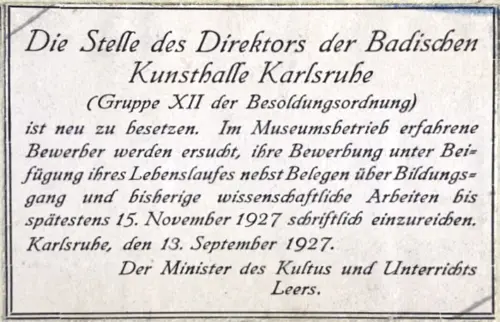
Advertisement from September 1927
The position of Director of the Badische Kunsthalle Karlsruhe (Group XII of the salary regulations) is to be filled. Applicants with experience in museum operations are requested to submit their application in writing, including a curriculum vitae along with documentation of their educational background and previous scholarly work, no later than November 15, 1927. Karlsruhe, September 13, 1927. The Minister of Culture and Education, Leers.
Candidate 1 – Dr. Walter Riezler
The Baden Ministry of Culture initially favored Dr. Walter Riezler, director of the Stettin Municipal Museum, and proposed him as a candidate to the Baden State Ministry on December 14, 1927, after all terms had been negotiated. However, there was resistance, some of which was unrelated to professional qualifications. Rumors about Riezler’s candidacy had already been circulating, and in a letter to the State Ministry dated November 28, 1927, Professor Carl Neumann, head of the Art History Institute at Heidelberg University, pointed out that Riezler, acting as an expert "on the canal issue, had entirely committed himself to Stuttgart's interests" and argued that the Kunsthalle needed "a connoisseur of old master art." Riezler, by contrast, was a proven advocate of modernism.
The canal issue concerned the construction of the Rhine-Neckar Canal from Stuttgart to Mannheim. This project was controversial in Baden, as there were fears that the Baden landscape along the Neckar would be destroyed. After an article appeared in the Heidelberger Tagblatt on December 19, 1927, addressing Riezler's stance on the canal issue, the Baden State Ministry issued a letter on December 28, 1927, requesting the Ministry of Culture to name additional candidates. The Ministry of Culture then tried to persuade Riezler to withdraw his application. However, he refused and instead demanded clarification as to who had conspired against him. In the cabinet meeting of the Baden State Ministry on February 13, 1928, a line was finally drawn under this appointment when it was determined that "a majority for Dr. Riezler does not exist." On February 28, 1928, an article appeared in the Frankfurter Zeitung titled "An Impossible Procedure: Who Will Be Director of the Karlsruhe Kunsthalle?" It stated that with Riezler's rejection, "a less-than-glorious chapter of Baden art policy has reached its preliminary conclusion."
Candidate 2 – Dr. Alfred Wolters
Following this disaster, the Baden Ministry of Culture was under massive pressure and sought to clear the official nomination of another candidate with the State Ministry in advance. On March 23, 1928, they inquired whether there were any objections to the curator of the Städel Museum in Frankfurt, Dr. Alfred Wolters. There were none. However, Dr. Wolters had not actively applied, though he signaled interest; in his letter to the Baden Ministry of Culture dated April 2, 1928, he pointed out that the Württemberg Ministry of Culture had offered him the directorship of the Stuttgart Painting Gallery and that he had also been promised "a senior position with a greatly expanded field of responsibility in Frankfurt." Instead of immediately removing this candidate from the list, the ministry made its second mistake by entering into negotiations with him. Although Dr. Wolters was guaranteed a very competitive salary of 8,000 RM plus approximately 2,000 RM in annual allowances, he announced on May 3, 1928, that he would accept a "directorship offered to him by the Frankfurt city administration."
Candidate 3 – Dr. Kurt Zoege von Manteuffel
In a letter dated May 10, 1928, the Baden Ministry of Culture inquired with the director of the Dresden Kupferstichkabinett (Print Room) whether he would be interested in the position in Karlsruhe. He had reportedly been suggested by "authoritative experts." This means that this candidate, too, had not actively applied on his own. After he signaled interest, the Ministry of Culture inquired with the State Ministry on May 29, 1928, whether there were any objections to Dr. von Manteuffel. This was not the case. The Ministry of Culture subsequently entered into negotiations with von Manteuffel and, on June 20, 1928, finalized a contract guaranteeing him an annual salary of 9,500 RM plus approximately 2,000 RM in allowances. To recap: Lilli Fischel received a monthly salary of 584 RM including all allowances—amounting to approximately 7,000 RM per year. This put her roughly 4,500 RM below the offer made to von Manteuffel. This discrepancy will play an important role further below. Despite this incredible salary guarantee, von Manteuffel sent a telegram to the Baden Ministry of Culture on June 29, 1928: "withdrawing from appointment letter follows." In his letter, he explained his rejection as follows: "The Saxon Ministry of Public Education has [...] emphasized that it places the greatest value on the undersigned remaining in his current position and has arranged the conditions for his continued work in Dresden so accommodatingly that the undersigned believes he should not terminate his many years of service under these circumstances."
A Media Communication Disaster
After the third failure to fill the directorship, nothing happened at first. Although candidates continued to apply for the position, they were either put off or rejected. Clearly, the Ministry of Culture feared further embarrassment. It remains incomprehensible why they did not select any candidates who had applied on their own initiative—such as Hildebrand Gurlitt, the director of the König-Albert-Museum in Zwickau. He was the first candidate to contact the Baden Ministry of Culture, submitting a multi-page letter as early as November 9, 1927. No response from the Ministry of Culture to him is documented in the files. During this phase, they were focused on Dr. Riezler and were presumably very certain that this candidate would be appointed.
Eighteen months after von Manteuffel's rejection, the press was growing impatient. Rumors about new candidates continued to circulate. On December 30, 1929, the Volksfreund, the SPD (Social Democratic Party) newspaper in Baden, published an article titled "Where is the Kunsthalle Heading?" stating the following:
"Regarding the note published by us under the above heading, we have been informed that the Minister, who is primarily and foremost responsible for the appointment of a director for the Kunsthalle, is unaware of any plan to appoint a Mr. Gräf from Munich. The cliques arguing over this issue in their circles, without any mandate to influence the decision, would—according to the report—better serve the interests of art in our city if they refrained from spreading such notes. The 'Modernists' as well as the 'Traditionalists' should equally understand that such alarmist reports, which lack any factual basis, are not conducive to advancing the appointment process."
Lilli Fischel’s Name is Mentioned for the First Time
The media coverage continued unabated. On January 7, 1930, the Heidelberger Tagblatt wrote:
"In the 'visual arts,' there is still an orphaned leadership post. Since Storck's death—nearly two years ago—the Karlsruhe gallery has been, if not without direction (as the major Feuerbach exhibition was curated with taste and expertise), then certainly without a director. For a time, Wilhelm Hausenstein, the well-known art critic, was considered, but the offer was declined. Riezler from Stettin did not come either. The name of Otto Homburger is being mentioned. And now, some circles are advocating for the current deputy director, Miss Luise Fischel. That would make her the first female museum director in Germany. While her qualifications are undisputed, one cannot avoid considering whether a personality from the outside should be recruited instead—someone who, by virtue of their prestige and intellectual standing, would provide a much-needed enrichment to the artistic and cultural life here."
This must have been depressing for Lilli Fischel. The article appeared at a time when, due to illness, she was permitted to "remain absent from duty during the morning hours" for six weeks. During this phase, she received a letter dated December 18, 1929, from the Baden Ministry of Justice, informing her that the State Ministry, at the request of the Minister of Justice, had decided on December 8 to appoint her as a deputy member of the Expert Chamber for Art. Literally: "You are taking the place of the deceased director, Dr. Storck." With this, the new strategy of the Ministry of Culture was clear: the position would not be filled by an external candidate.
On May 13, 1930, the Ministry of Culture wrote to the Kunsthalle: "The question of the final appointment to the vacant director position at the Kunsthalle will be postponed for the 'duration of one year' (crossed out and overwritten by hand with 'until further notice'). The management of the director's duties and the entire administration of the Kunsthalle during this period shall remain entrusted to the curator, Miss Dr. Fischel."
Another reason for the open director position
In a letter dated July 23, 1930, the Ministry of Culture requested that the Ministry of Finance reclassify Lilli Fischel into salary group A2c, citing the "extraordinary additional workload" resulting from her assumption of the director's duties. However, 1930 marked the peak of the Great Depression, characterized by high unemployment and collapsing tax revenues. One emergency decree and austerity measure followed another—including in Baden.
"On August 1, 1930, the Baden Minister of Finance wrote to the Minister of Culture: 'I agree to the use of a partial amount of 10,000 RM for the renewal of the lighting and power supply lines at the Technical University. In view of the financial situation, however, I must urgently request that relief for the state treasury be provided elsewhere. [...] Finally, one possibility for relief regarding any eventual later balancing of accounts would be to draw upon the savings achieved by not filling the director position at the Badische Kunsthalle for 1931. [...] In any case, I most respectfully request notification of the measures taken to relieve the state treasury.'"
Only one day later, in a letter dated August 2, 1930, the Ministry of Culture wrote to the Minister of Finance: "The balancing of the cost overrun for the State Technical College, amounting to approximately 4,300 RM, is also expected to be covered in 1931 through further savings from the vacant director position at the Kunsthalle. Should the director position be filled contrary to expectations, I would provide further notice in due time regarding alternative savings."
In a letter dated October 9, 1930, the Ministry of Finance informed the Ministry of Culture that curator Dr. Luise Fischel would be reclassified into salary group A2c, effective October 1, 1930. However, a letter from the Ministry of Culture to the Minister of Finance dated December 24, 1931, reveals that due to a further austerity decree, Fischel's promotion to the higher salary group had not taken place as of October 1, 1930. The ministry now urgently demanded the implementation of the promotion, stating that otherwise the funds saved by keeping the directorship vacant would be reclaimed.
Lilli Fischel de facto performed the duties of the director from March 1927 until her dismissal in March 1933—a total of six years. During this period, the State of Baden withheld more than 4,300 RM in annual salary from her. Considering that she did not reach the highest salary level until 1931, it can be estimated that the total sum eventually amounted to between 35,000 and 40,000 RM.
Conclusion
By way of the salary withheld from her, Lilli Fischel effectively financed the renovation of other state institutions. Today, this would be called wage dumping. The fact that the economic exploitation of her professional excellence transitioned seamlessly into racial persecution beginning in 1933 is another dark chapter in the history of Karlsruhe's museums. Since these connections have received little attention from an art historical perspective, we have reported on them in more detail than originally planned. Therefore, we will stop here and report on them in the next two newsletters under the following titles:
- Part 2 - Her Struggle for Modern Art
- Part 3 - Her Struggle for Restitution
Sources
The above information regarding Fischel's academic career is documented in file GLA 441-2 533. The information concerning the appointment to the director's position comes from file GLA 235-40 248 of the Generallandesarchiv in Karlsruhe (State Archives).
Notes on the Above Portrait of Lilli Fischel