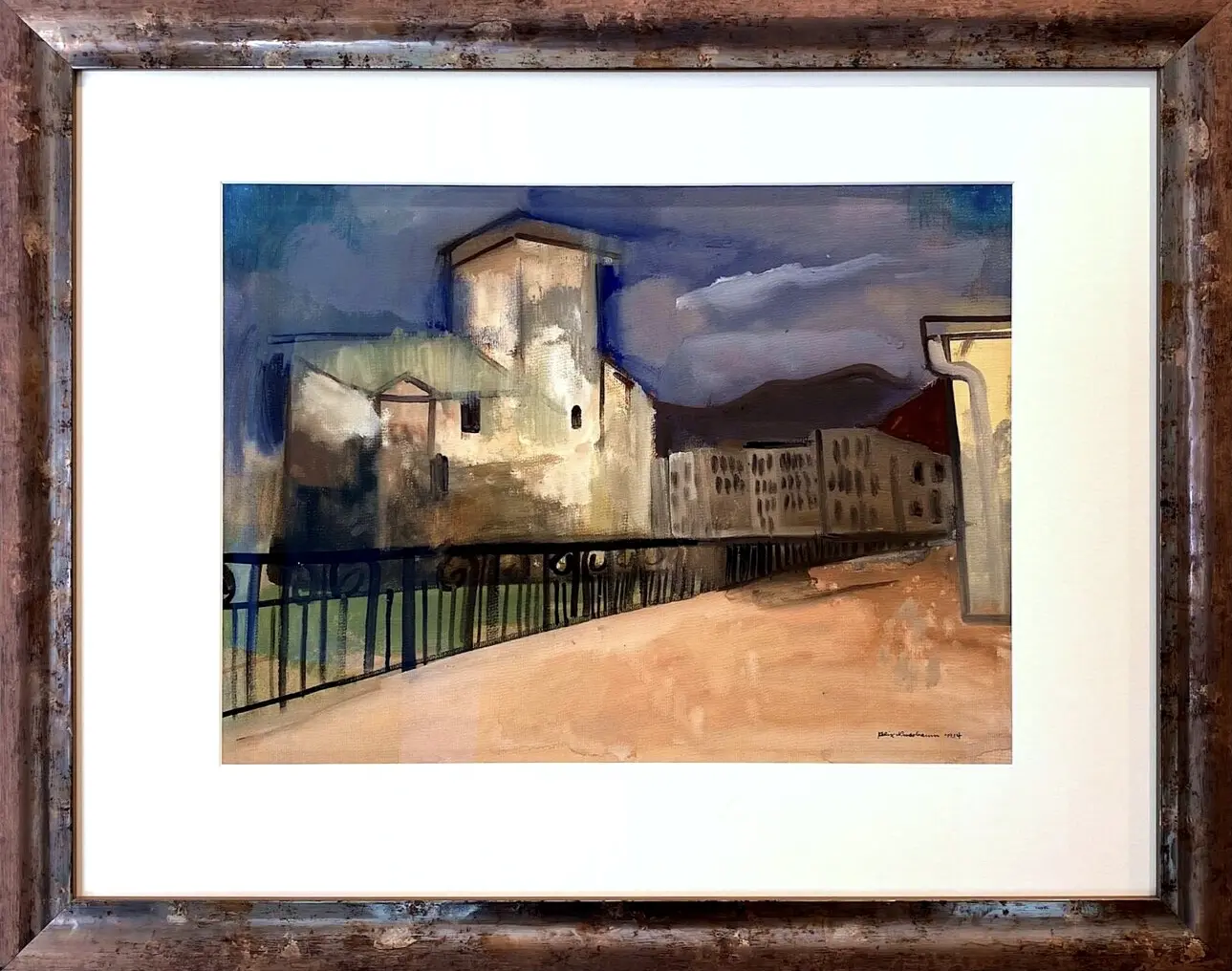
Felix Nussbaum’s gouache Schloss in Rapallo (Castle in Rapallo) was created in the summer of 1934 on the Italian Riviera. Following the loss of his Villa Massimo fellowship in Rome (1933), this stay marked the beginning of his years on the run from the Nazis. It was not a carefree vacation, but rather a final reunion with his Jewish parents before their deportation—an encounter overshadowed by profound uncertainty. This traumatic situation also forced an artistic shift: lacking a studio, Nussbaum turned away from oil painting and discovered the practicality of gouache on paper.
The work depicts the Castello sul Mare, a 16th-century fortress situated directly on the coast. Nussbaum chooses a slightly elevated, detached perspective, focusing on the defensive character of the architecture rather than a romantic postcard motif. The composition follows a strict geometry: the castle heavily occupies the left half of the picture, while the quay wall in the foreground acts as a visual barrier, rigorously separating the viewer’s space from the pictorial space. This oppressive scenery is heightened by the gloomy sky, overcast with dark clouds, looming ominously over the bay. Also striking is the absolute absence of people—a central psychological motif in Nussbaum’s exile art. Where the Mediterranean light should invite vitality, a paralyzing, melancholic silence prevails. The castle mutates into a symbol of a fortress or an unreachable sanctuary.
The velvety-matte gouache paint covers the surfaces heavily, yet simultaneously allows the fine texture of the paper to shimmer through with vitality. The color palette consciously rejects any naive colorfulness. Earthy, warm ocher and sienna tones dominate the castle walls, standing in stark contrast to the cool, heavy blues of the Ligurian Sea. The light, although defined by sharp shadows, radiates no warmth. It is a cold, analytical light that cuts the contours and harshly illuminates the loneliness of the place. The controlled, flat brushwork lends the scenery a peculiar, almost surreal rigidity.
Stylistically, the work stands in the tradition of New Objectivity (Neue Sachlichkeit), yet here it already opens up to the influences of the Italian Pittura Metafisica (Metaphysical Painting) of a Giorgio de Chirico. This movement used lifeless architecture to express feelings of alienation and melancholy. The painting thus becomes a psychological self-testimony disguised as a classical veduta. Instead of depicting the Italian coast as an idyllic vacation spot, Nussbaum uses architecture as a political cipher: the defensive, isolated fortress reflects the artist’s real threat, his exclusion from his homeland, and the painful certainty that the southern idyll is merely a temporary backdrop on the path to the final catastrophe of exile.
| 1934 | Created in Rapallo |
| after 1934 | In the possession of an unnamed artist who was a friend of Nussbaum’s |
| after 1939 | In the possession of an unnamed female Spanish emigrant who operated a tavern with rooms for rent in the Marolles district. (Gifted by the aforementioned artist upon moving out) |
| after 1977 | In the possession of the niece (Juanita Esdrada Menéndez, born in Asturias, †2021) of the aforementioned tavern owner. (Gifted upon the owner’s return to Spain following Franco’s death) |
| from 2013 | In the possession of Max de Brouwer, Brussels. (Acquired by helping to clear the apartment on Rue des Visitandines, Marolles district, Brussels, belonging to Juanita Esdrada Menéndez prior to her emigration to Spain) |
| 2018 | Auctioned on June 1 at the Lempertz Auction House, Cologne, Auction 1111 (Modern Art), Lot 490, to Kunsthandel Henneken, Bad Iburg. (Consigned by Max de Brouwer) |
| 2026 | Acquired by the “Lost Generation Art” Collection Karlsruhe from Kunsthandel Henneken |
Although the identity of the artist friend remains unknown, the historical scenario surrounding the transfer of our work to a Spanish tavern owner in the Marolles district of Brussels in the 1930s can be precisely reconstructed. At the time, the Marolles district was the epicenter for destitute Jewish and anti-fascist refugees. The mention of a "Spanish tavern owner" is a striking contemporary detail: following the end of the Spanish Civil War and Franco's victory on April 1, 1939, a mass exodus to France took place. France was completely overwhelmed and confined the people to improvised internment camps on the beaches. Anyone who had the opportunity, contacts, or money immediately fled these camps for major Western European cities, such as Brussels. As a result, starting in 1939, a tight-knit network of Spanish Republican refugees emerged in the Marolles—particularly on streets like Rue Blaes, Rue Haute, or Rue du Miroir near the Place du Jeu de Balle—where they operated modest boarding houses.
The fact that our work remained with the boarding house owner after the artist friend moved out can be plausibly explained by the fact that unpaid rent was often settled with artworks or material assets instead of cash. Following Franco’s death in 1975 and the Spanish Amnesty Law in 1977, a major wave of repatriation to Spain began. It was likely during this period that the aforementioned owner returned to Spain, and our work remained with her niece.