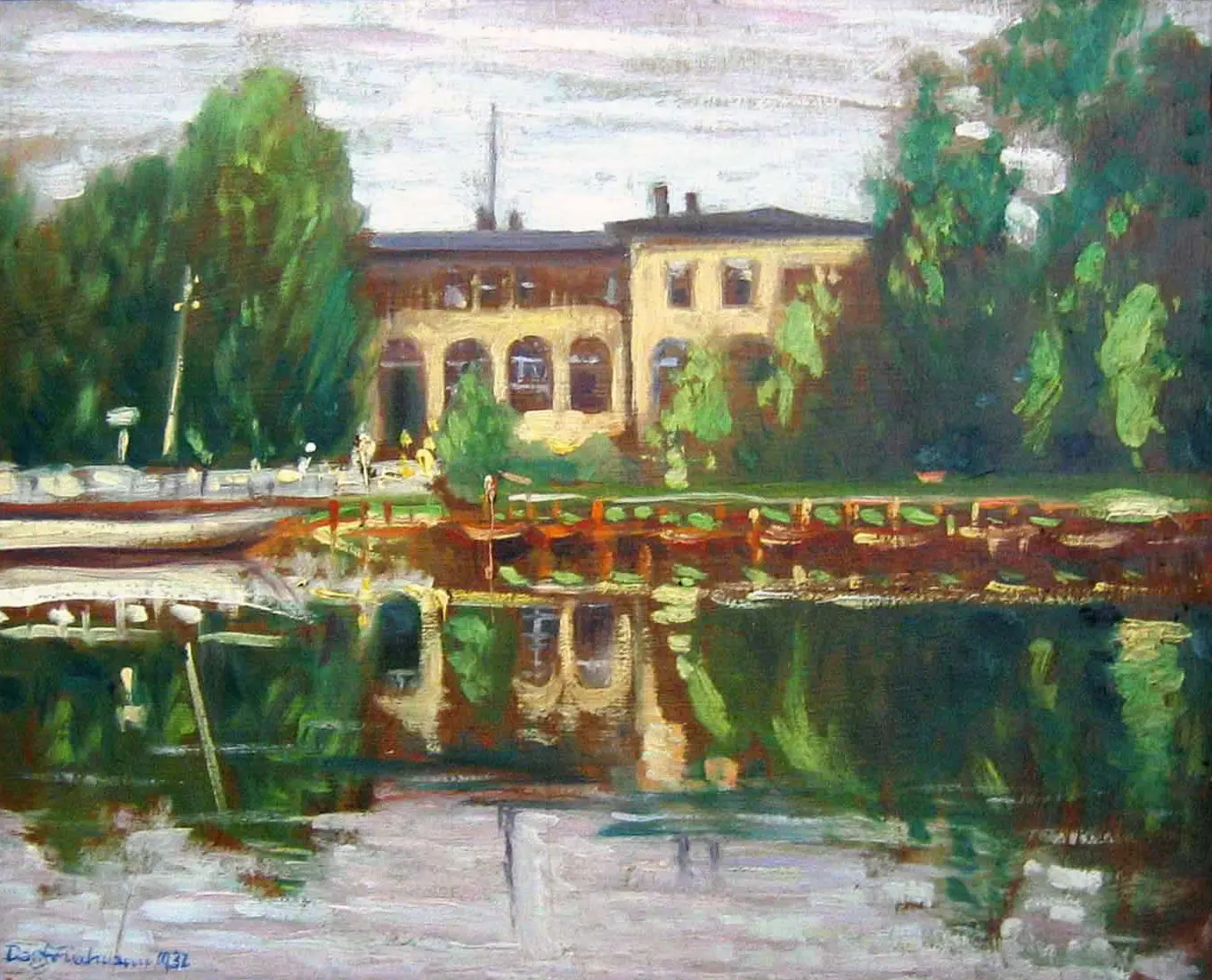
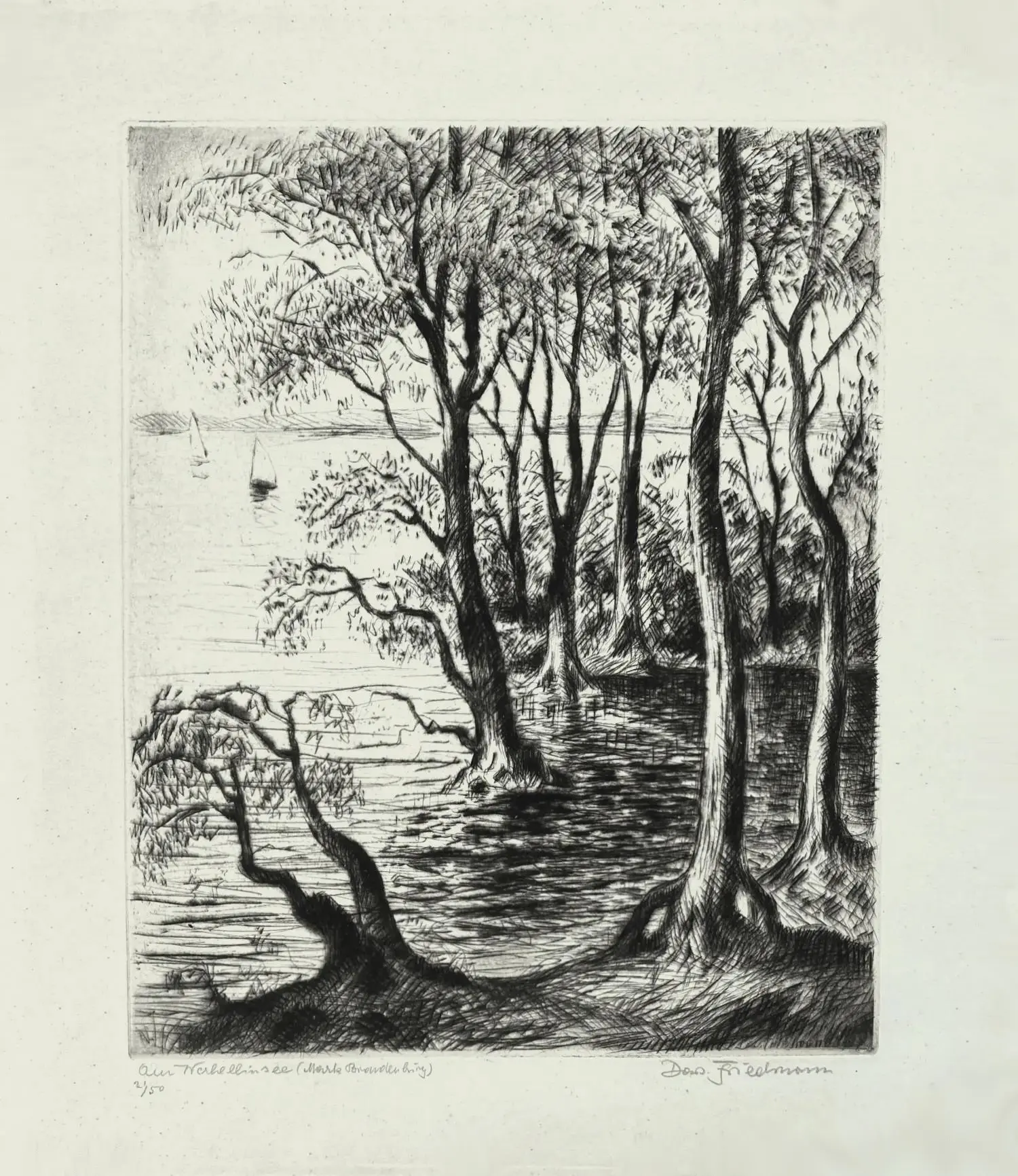
 At Lake Werbellin
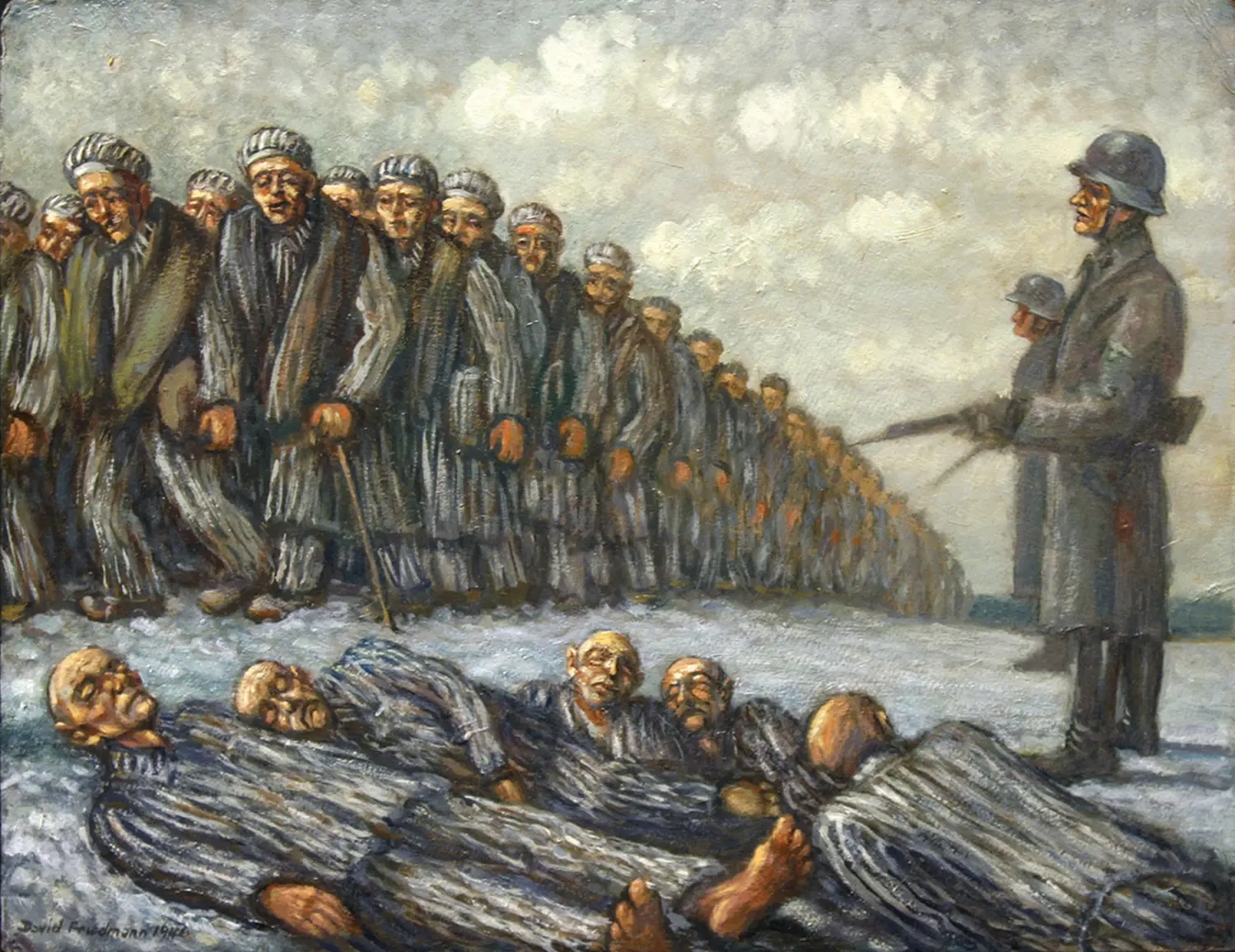
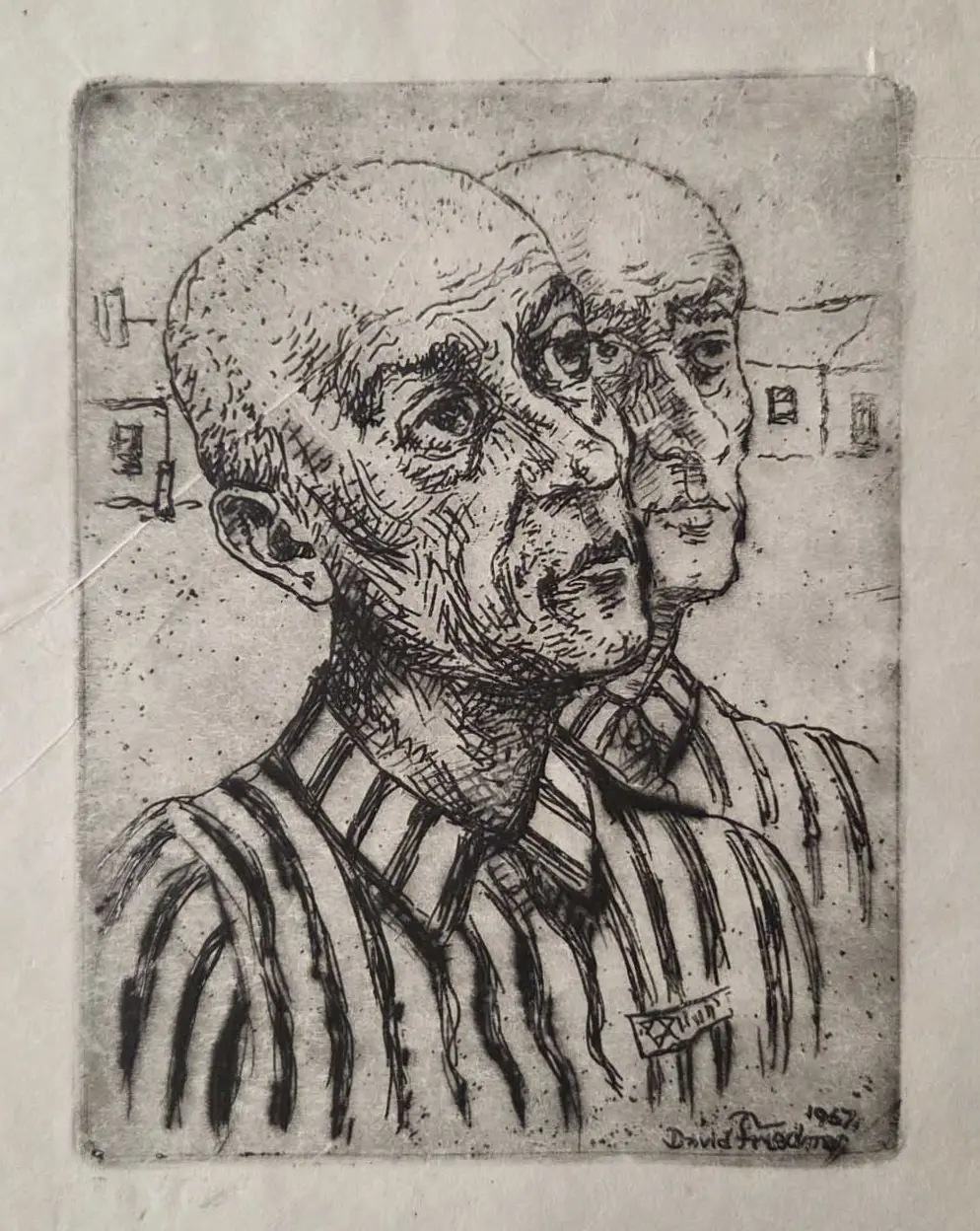 Jewish Concentration Camp Prisoners at Roll Call
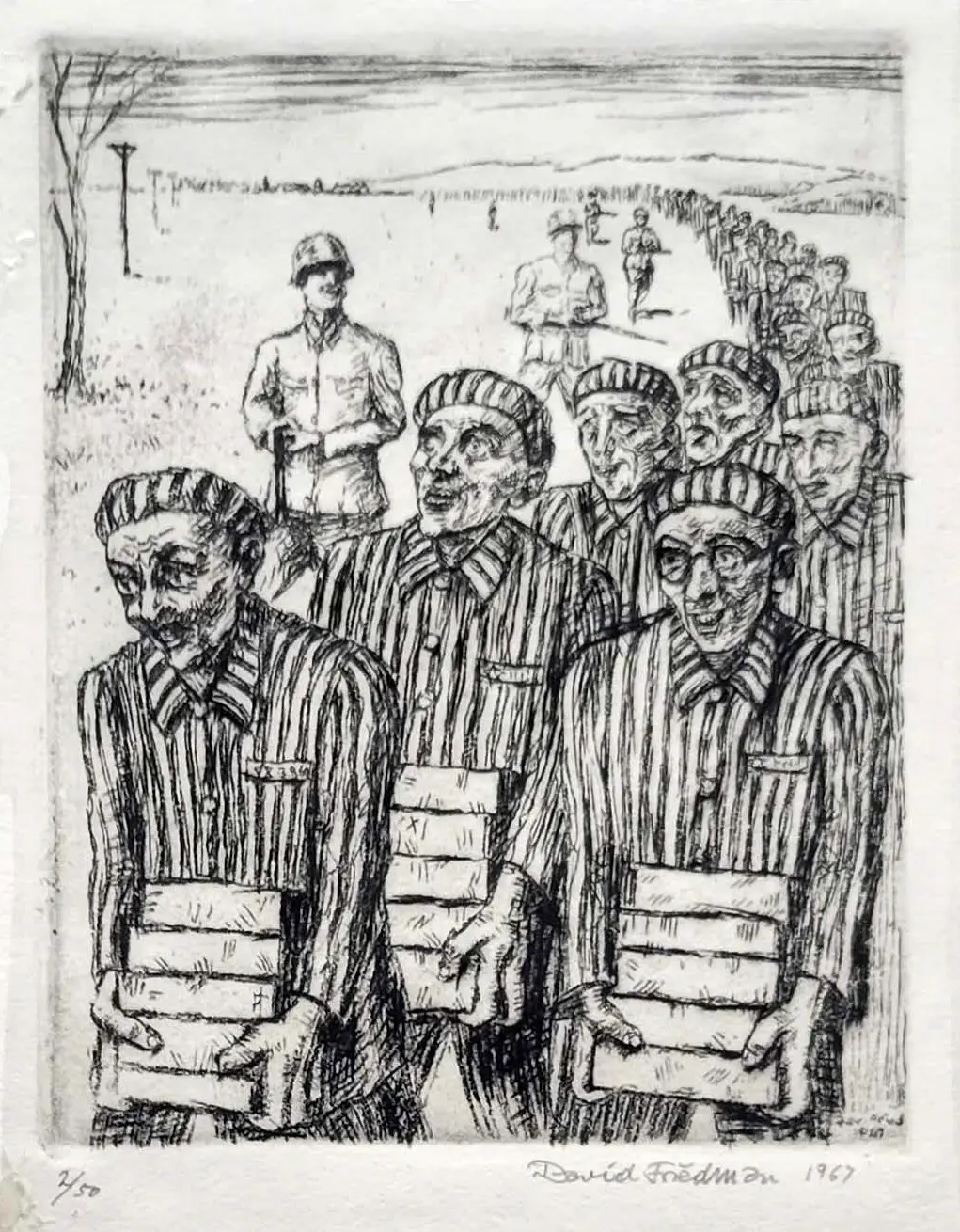 Jewish Concentration Camp Prisoners Carrying Bricks
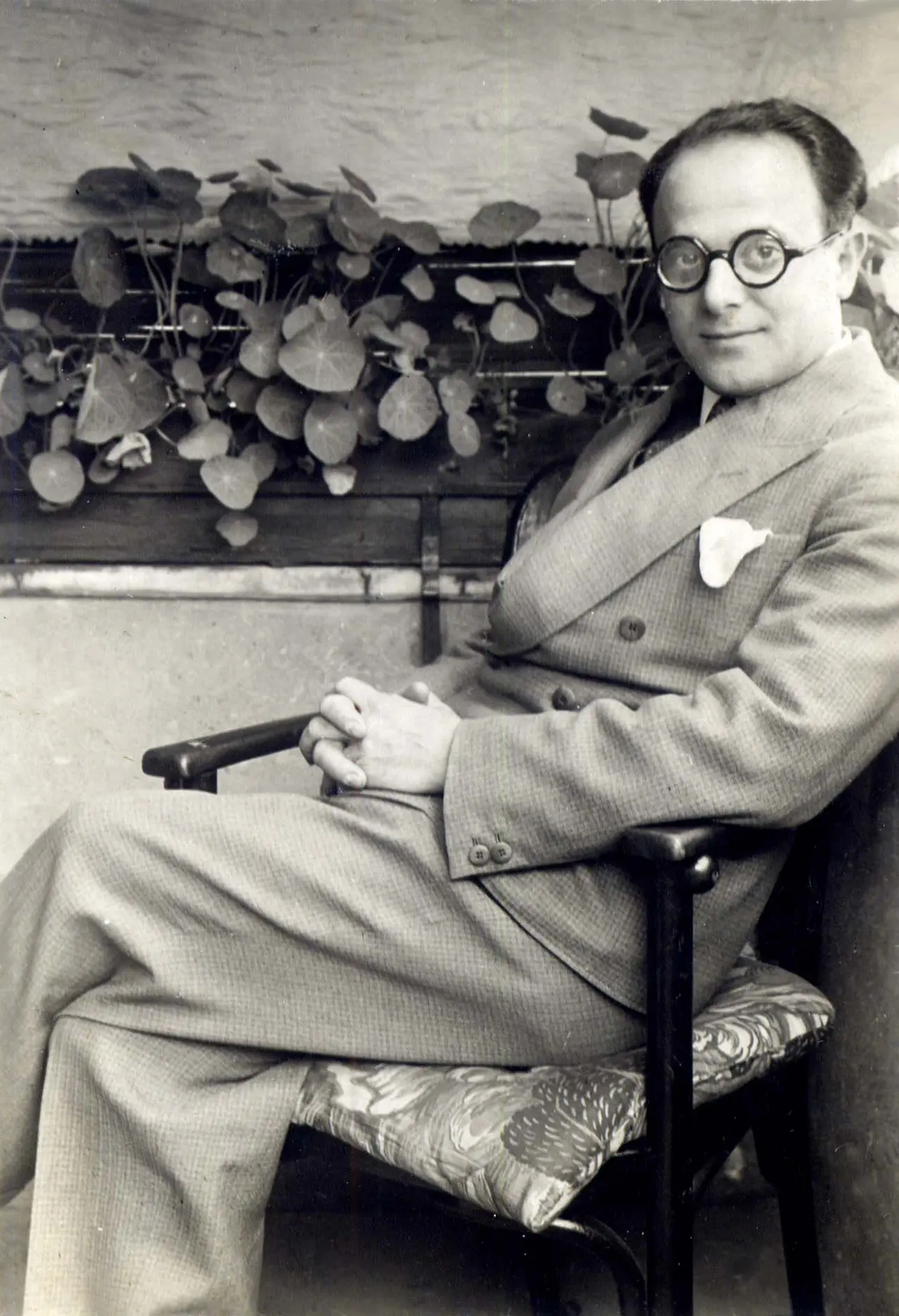
The life of David Friedmann (also known as David Friedman) is far more than an artist's biography; It is a poignant historical testament of the 20th century. As a painter, graphic artist, and chronicler, Friedmann lived through the extremes of modern history—from the cultural brilliance of his Berlin years to the deepest abysses of the Holocaust, and finally to a difficult yet triumphant new beginning in the United States of America. Today, his work stands as a symbol of the indomitable human spirit and of the documentary power of art as a means of human self-assertion in the face of total dehumanization. The following biography was in collaboration with David Friedmann’s daughter, Miriam Friedman Morris, who also wrote the English translation.
David Friedmann was born on December 20, 1893, in Mährisch-Ostrau (today Ostrava in the Czech Republic), then part of Austria-Hungary. The son of a tinsmith, he grew up under very modest circumstances. He initially trained as a sign painter, but amidst the atmosphere of cultural awakening at the beginning of the twentieth century, his artistic spirit developed in a rare duality of the arts. Before Berlin transformed him into a chronicler of modernity, Friedmann first found his artistic identity in the symbiosis of image and sound. He began studying music—the violin became his closest companion, whose discipline and rhythm would later be reflected in his lively and precise drawing style. Yet his urge toward visual form proved stronger: in 1911, at the age of seventeen, he moved to the vibrant art metropolis of Berlin.
In Berlin, Friedmann initially worked as a sign painter and later as a stage painter. At the same time, he took private lessons in art and violin. When he showed his studies to Max Liebermann, he recommended him to Lovis Corinth, who accepted David Friedmann into his master class in 1914. Corinth taught him the fundamentals of modern oil painting. At the same time, Friedmann learned the art of etching from Hermann Struck. On Corinth’s advice, he opened his own studio in 1914 at Xantener Straße 23.
During the First World War, Friedmann served as a war artist in the Austro-Hungarian Army. After the founding of Czechoslovakia at the end of the war, he became a Czechoslovak citizen and returned to his Berlin studio. There, he established himself as a successful artist, creating works with Jewish themes, impressionistic landscapes, still lifes, interiors, nudes, and portraits. Between 1919 and 1933, his works were regularly exhibited at the Berlin Academy of Arts, the Berlin Secession, and in other cities such as Hamburg, Dresden, and Munich.
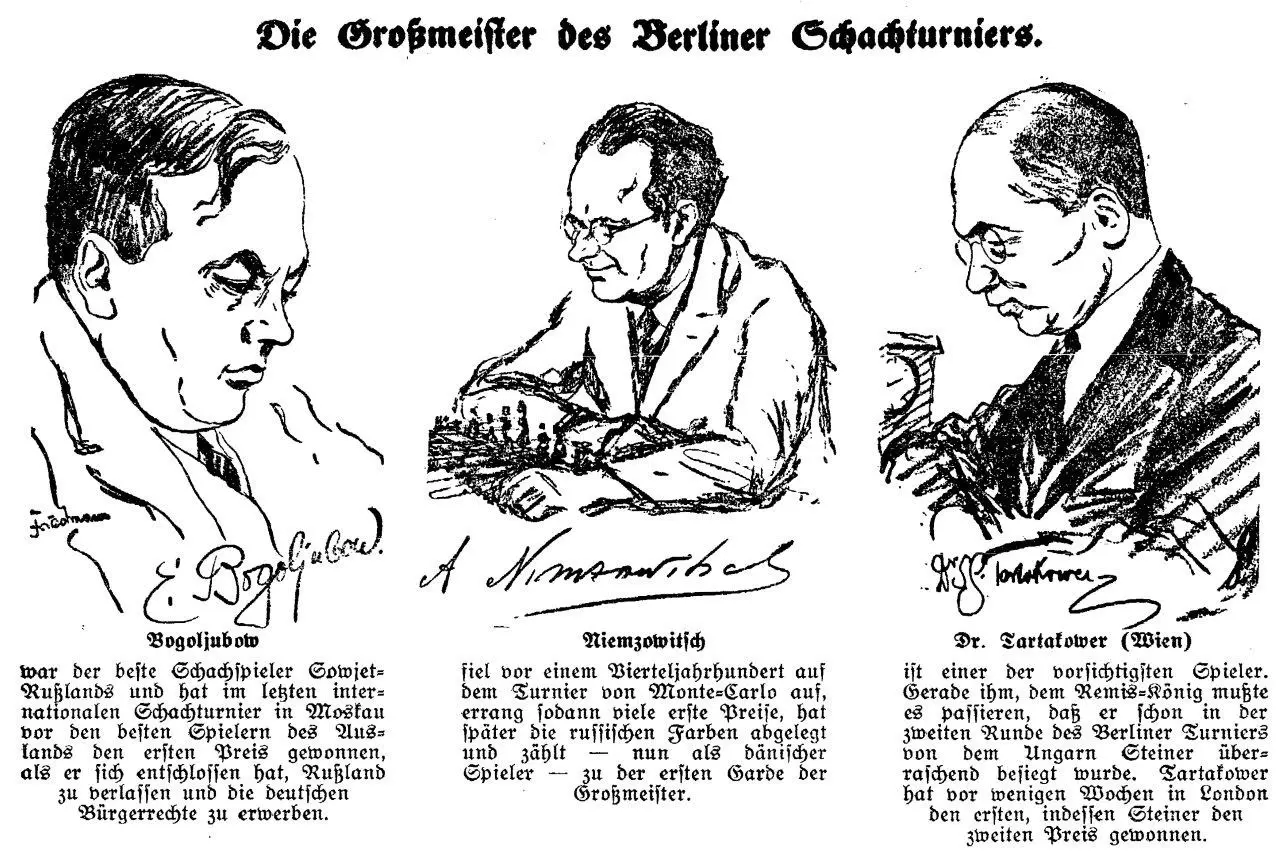
David Friedmann possessed the rare gift of capturing the essence of a person within seconds. Whether depicting chess world champions in concentration, politicians in the Reichstag, or stars of the cabaret stage, Friedmann’s portraits shaped the visual identity of Berlin’s major daily newspapers. Because contemporary reporting still lacked compact camera technology and photographic snapshots, newspapers relied on skilled press illustrators. In this environment, Friedmann became one of the most distinguished illustrators of the Weimar Republic.
Friedmann’s sketchbooks brought together the influential figures of an entire era. With a swift and confident line, he portrayed the intellectual and artistic elite—from Nobel laureates Albert Einstein and Thomas Mann to the “painter prince” Max Liebermann, as well as international statesmen such as British Prime Minister Ramsay MacDonald. Friedmann was no distant observer; he worked at the very centers of power of the Republic, documenting the political and cultural dynamics of the Weimar years. This remarkable career came to an abrupt end with the rise of the National Socialists. In 1933, as a Jew, he was banned from his profession and ordered to remove his works from all galleries. He lost not only his livelihood but also became the target of systematic persecution.
After the abrupt end of his artistic career in 1933, Friedmann gave up his studio and founded a painting company that renovated apartments and houses. In 1937, he married Mathilde Fuchs, and in 1938 their daughter Mirjam Helene was born. Following the November Pogrom (Kristallnacht) on November 9, 1938, Friedmann was forced to close his company and dismiss all employees.
In an autobiography written in 1945, Friedmann later recalled:
“After Hitler’s accession to power in 1933, my artistic activities came to an abrupt end. I could practice my art only within the limited circle of my Jewish friends. At the end of 1938, In late 1938, external circumstances compelled me to flee Berlin in haste with my wife and my three-month-old child.”
David Friedmann fled with his family to Prague, where he could work as an artist again. However, after the Wehrmacht entered the Czech capital on March 15, 1939, he found himself in the same situation as in Berlin only months earlier. In October 1941, the family was deported to the Litzmannstadt Ghetto (today Łódź). In 1944, they were deported to Auschwitz-Birkenau. His wife and six-year-old daughter were murdered in the gas chambers of Auschwitz, while Friedmann’s talent for drawing and painting saved his life in the Gleiwitz I subcamp. Friedmann portrayed SS officers and, secretly, fellow prisoners—an act that was strictly forbidden.
As the Red Army advanced from the east, the prisoners were sent on a death march westward to the Blechhammer labor camp on January 18 (see image on the right – not part of the collection). Friedmann survived the 45-kilometer march in extreme cold. On January 21, the survivors arrived in Blechhammer and were subsequently driven further west by the SS. Friedmann managed to hide with other exhausted prisoners in the camp, thereby escaping certain death. He was liberated by the Red Army on January 25, 1945. Upon liberation, only a few prisoners were found alive.
In retrospect, David Friedmann recounts in his autobiography the period spent in the ghetto up to his liberation as follows:
“My senses and eyes eagerly absorbed all the unusual impressions. In the unending misery, I found motifs that had always interested me. With death before my eyes, through hunger and sickness, I worked strenuously on a series of drawings, etchings and paintings, which documented our fate. At the end of August 1944, this ghetto was evacuated. We were taken to the extermination camp Auschwitz, where I had to hand over all my belongings, including my artistic documents. At the time, I did not yet know that my wife and my six-year-old child would perish in the gas chambers of Auschwitz. And further I came via the Gleiwitz concentration camp to the Blechhammer concentration camp, where my comrades and I were liberated by the Red Army on January 25, 1945.”
In the following months, Friedmann went via Krakow and Mährisch-Ostrau to Prague, hoping to find his wife and daughter. His search remained unsuccessful. Regarding this traumatic experience, he writes:
“We walked behind the Front in the direction of Krakow, where I stayed until Czechoslovakia was freed. Then I made my way alone to Mährisch Ostrau arriving there May 12, 1945. My first stop was to the graves of my parents after which I registered with the police who showed me the way to the Jewish Community. In Prague, I searched in vain for my wife and child. Only now I felt strongly what I was lacking, and so came the breakdown. I placed myself in doctor’s care however, no one could help me.”
Only later did he learn that Mathilde and Mirjam Helene had been murdered. In January 1946, he met his second wife, Hildegard Taussig, a fellow Holocaust survivor, at a convalescence hotel in Český Dub dedicated to the rehabilitation of survivors.They married in Prague on May 27, 1948. Between 1945 and 1948, Friedmann created his first works addressing the atrocities he had experienced in the concentration camps. He titled this series “Because They Were Jews!” Regarding his motivation, he writes in his autobiography:
“Torn out from my memory, I consider these first black and white sketches as the beginning of a new direction, which I must now follow as a result of my life experience.”
Friedmann’s first post-liberation exhibition at the Český Dub town hall was one of the world's earliest displays of Holocaust art. Due to the Stalinist policies of the new communist government in Czechoslovakia and growing antisemitism, the couple decided to flee once more.
In search of safety and permanent exile, David Friedmann and his wife emigrated to the newly founded State of Israel in 1949. After his arrival, Friedmann worked in a sign shop in Tel Aviv. Around 1951, he became self-employed with his own graphic and advertising studio. He used his skills as an illustrator to design posters and informational materials, while in his free painting time he captured the country's sun-drenched landscapes in vibrant colors.
The works of these years radiate optimism and vitality—they were the artistic expression of a hard-won new beginning in a new homeland. Nevertheless, his existence in Israel remained financially precarious. Friedmann struggled to support himself and his family in the young state. As a result, in 1954 he made another courageous decision: to emigrate to the United States of America.
In St. Louis, Missouri, Friedmann began an impressive second career at the age of over 60. The fact that he spoke hardly any English at the beginning makes his success in the United States even more remarkable. He demonstrated his graphic versatility and successfully established himself in the American advertising industry. As a specialist in large-format outdoor advertising at the General Outdoor Advertising Company, he artistically executed designs as hand-painted billboards.
Friedmann writes:
I had to forget about art paintings, and I had to forget what was hidden in the inner part of my heart, the pictures from the concentration camps. I had to work first to make a living and to be one of the top painters in the company. I had to work hard because my age was 61 years. However, General Outdoor Advertising did not care about my age. They were looking how fast I could produce the gigantic paintings. (edited)
Friedmann produced more than 150 billboards, representing companies such as Hunt’s Tomato Sauce, 7‑UP, Budweiser, and Falstaff Beer. Instead of scenes depicting Nazi atrocities, he now painted the iconic Budweiser Clydesdales and happy folks selling beer from two-story tall billboards.
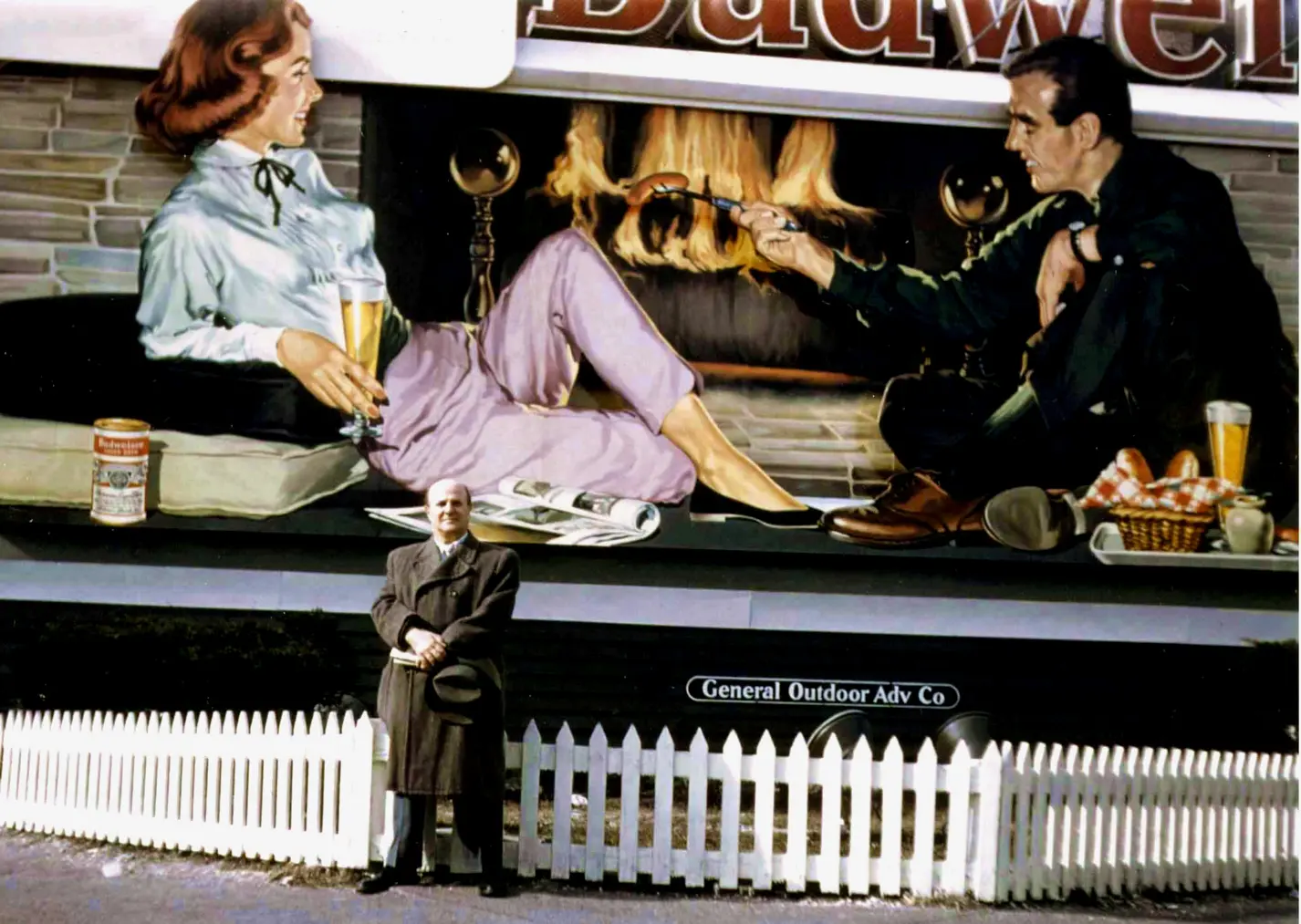
David Friedmann in 1958 in front of one of his billboards advertising Budweiser
This opportunity gave him reason to believe there was still a place where his ability as a painter could be respected. The new career brought recognition and satisfaction with life in America. David Friedmann and his family became American citizens and changed the spelling of their surname to Friedman.
Upon retiring, he devoted himself fully to confronting his past and, ten years after his arrival in the United States, began a second artistic engagement with his experiences in the extermination camps. With his retirement, he devoted himself once again with full energy to coming to terms with his past and, ten years after his arrival in the USA, began to artistically work through what he had experienced in the extermination camps for a second time.
He again titled this series “Because They Were Jews!” Two of these works are now part of our collection and displayed at the top of the page. In the etching, “Prisoners Carrying Bricks,” he depicts himself as the prisoner wearing eyeglasses to show he was not just a witness, but also a victim (Front right). These dark and profoundly moving drawings stand in stark contrast to his luminous Israeli landscapes and are based on his phenomenal visual memory. Friedmann remained tirelessly active until his death on February 27, 1980.
Today, his works are among the most important visual documents of the Holocaust. His artistic legacy is preserved in major institutions such as Yad Vashem, the United States Holocaust Memorial Museum, the Leo Baeck Institute (New York/Berlin), and the Centrum Judaicum in Berlin—testimony to a man whose creative spirit was not broken by history.
One year after the Wehrmacht entered Prague, in early 1940, David Friedmann inquired with the Gestapo about the possibility of returning to Berlin. When this was denied, he commissioned his brother in the spring of 1940 to place the entire furnishings of his Berlin apartment into storage at the Silberstein & Co. forwarding company. He entrusted his valuables and important artwork to his father-in-law. Both the warehouse and his father-in-law’s apartment were later looted. Following his deportation to the Litzmannstadt Ghetto in October 1941, his works in his Prague apartment were confiscated by the Nazi authorities. In addition to the furnishings of his home and studio, Friedmann lost several hundred oil paintings and graphic works. The whereabouts of these works remain unknown to this day. It is presumed that a large portion of them were destroyed.
After the war, Friedmann was among the first artists to receive compensation for looted and confiscated artworks. His restitution case was titled “The Artist David Friedmann versus the German Reich” In 1961, the International Supreme Restitution Court in Berlin awarded him a total of 17,500 Deutsche Marks in compensation for losses incurred due to looting in Berlin.
The ruling of the Supreme Restitution Court, an internationally staffed tribunal established by the Allies in 1953, was a significant victory for David Friedmann. However, it took nearly eight years for the court to reach a decision. During this time, Friedmann had to prove that the artworks had existed and establish their value—an almost impossible task. He was also required to submit sworn affidavits from witnesses to corroborate his claims.
The works by Friedmann that survived from the prewar period, as well as those painted after the war, are held today in numerous museums and public collections worldwide.
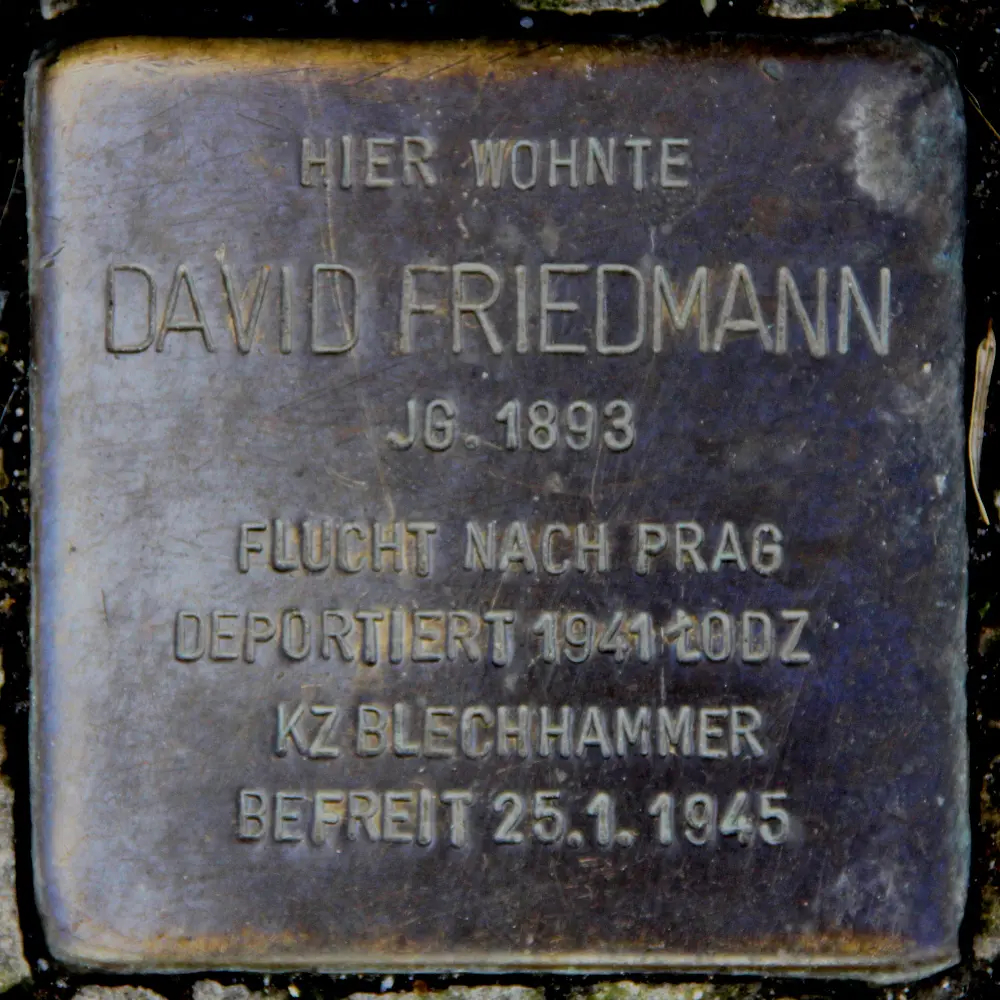
The continued visibility of David Friedmann’s life’s work today is inseparably linked to the decades-long commitment of his daughter, Miriam Friedman Morris. Born in Israel and raised in the United States, she devoted her life to reconstructing her father’s lost and largely plundered oeuvre and making it accessible to the public. Her work represents not merely the stewardship of a family estate, but an active contribution to the visual documentation of the Holocaust. She has presented her father's works at many lectures and events.
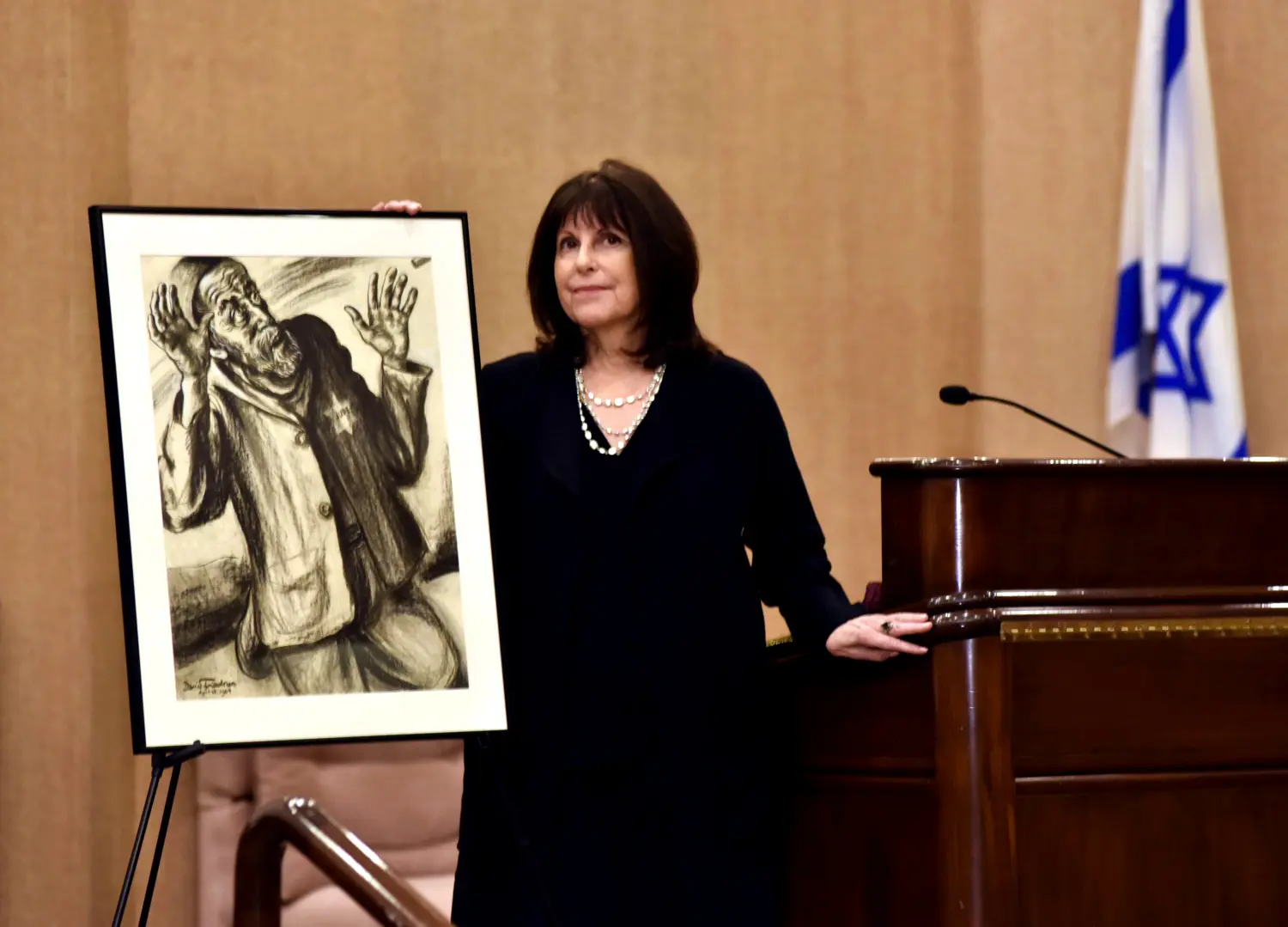
Miriam Friedman Morris, keynote speaker at the 2019 commemoration of Kristallnacht in Rockland County, New York (Photo: Jeff Karg)
We owe the work in our collection to Miriam Friedman Morris and Karin Handschuh. It is an etching created around 1925. Exactly one hundred years later, in 2025, it resurfaced in a donation box at a second-hand shop in Quedlinburg. Because the frame was damaged, the picture could not be hung and was moved from one corner to another for a year, until the shop employee Karin Handschuh, captivated by the motif, took the picture home and repaired the frame.
As the work was clearly signed, she wanted to learn who David Friedmann was and, in her research, came across his daughter Miriam, who lives in New York. Miriam confirmed that the work was by her father, who had dropped the second “n” from his surname upon his naturalization in the United States.
The shop owner, Mareike Fux, and her employee Karin Handschuh then decided not to sell the picture but to gift it to Miriam Friedman Morris. Since Miriam already owned an etching of the motif “At Lake Werbellin” and had recently discovered our website, she emailed us asking: “Do you know David Friedmann?” Naturally, we did—and replied that, unfortunately, we did not yet own a work by him. Her response: “Then you have one now!” The two discoverers of the work from Quedlinburg agreed with this solution and sent us the etching by post. It now remains permanently on display and can be viewed in full size here.
Below is a report from the Mitteldeutsche Zeitung dated February 2, 2026, regarding this extraordinary discovery:
Digitalized article, February 2, 2026
Reprinted with the kind permission of the MZ
David Friedman was not alone in the vibrant media world of the Weimar Republic. In the press galleries of the Reichstag and the artist cafés of Berlin, he regularly encountered his colleague Emil Stumpp (1886–1941), whose works can also be found in our collection. Both belonged to the absolute elite of German press illustrators, capturing the defining personalities of the first German democracy for the major daily newspapers with swift, masterful strokes. Although Emil Stumpp was not Jewish, his life was ended by Nazi henchmen in 1941 at the age of 55.