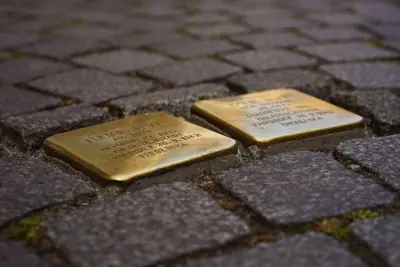

In addition to presenting works by lost artists, we also see it as our mission to research and subsequently present their biographies. In the German Wikipedia, there is a “List of visual artists persecuted by the Nazi regime,” which still contains many blind spots—shown in red. This list currently includes around 250 names, about 90 of which do not yet have an article. We believe that these artists should at least have their own Wikipedia article. For this reason, in recent years we have created 27 new biographies for Wikipedia, thereby reducing the number of blind spots by 25%. For Jewish artists, we pass on this information in the form of Pages of Testimony to the central database of Holocaust victims at Yad Vashem. If no Stolperstein (stumbling stone) exists yet, we also apply for one.
The Wikipedia list mainly includes artists who had a connection to the German Reich. The total number of artists in Europe who were persecuted or murdered by the Nazi regime is many times higher. Exact figures are still unknown to this day. In 2019, the “Jewish Digital Cultural Recovery Project” (JDCRP) foundation was established with the aim of determining this number. In the summer of 2025, a first list was published. It currently includes 1,500 artists who were persecuted by the Nazi regime or who died as a result of it. In addition, the foundation has set itself the task of determining the number of Jewish collectors who, as part of the measures taken by the Nazi regime, were either murdered, persecuted and dispossessed, or forced to sell their works below value. This list currently contains around 3,700 individuals. Despite its presumed incompleteness, it makes the scale of the persecution of artists and collectors visible for the first time.
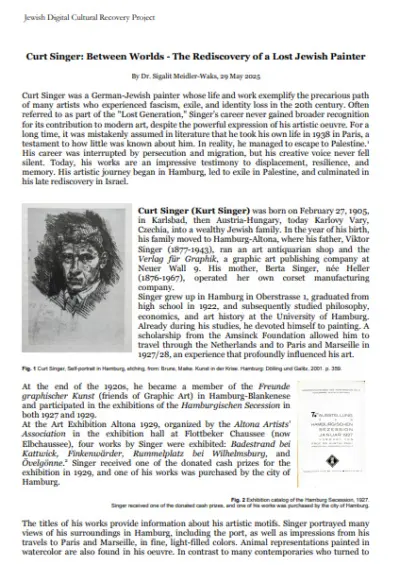
As a representative example for the artists, we present here the biography of Curt Singer, who grew up in Hamburg and, according to art-historical research in Germany, was believed to have taken his own life in Paris in 1938. In fact, Curt Singer died on April 10, 1989, in Kibbutz Nir Oz in Israel. This very case—in which the biography was assumed to be settled for decades—demonstrates how important this topic remains today. We were able to clarify this historical faux pas after acquiring an oil painting by Curt Singer from 1928. At that time, Singer was a blind spot on the Wikipedia list.
In his offer, the seller of the work wrote: “A very rare work by this important Hamburg artist. There are exceptionally few works by him in museums and collections, as Singer had only a relatively short creative period. Due to private, economic, and political circumstances in his life, Curt Singer increasingly suffered from depression and sought to take his own life in Paris in 1938.” At the time of our purchase of the painting in January 2023, this reflected the state of art-historical research in Germany.
Since there was no Wikipedia entry, we began researching the biography, and shortly thereafter the first inconsistencies emerged. Here you can find the complete biography of Curt Singer and the final results of our research.
In February 2025, we received an inquiry from the JDCRP regarding the biography of Curt Singer on our website. This was in preparation for the publication of the first list of persecuted artists, for which a case study on Curt Singer—PDF see above—was to be published on the JDCRP website. This was done, on the one hand, because we uncovered the unusual aspects of this biography, and on the other hand, because a granddaughter of Curt Singer was taken hostage during the Hamas attack on Kibbutz Nir Oz in October 2023 and was released in January 2025.
Note regarding the header image
Aufn.-Nr.: df_hauptkatalog_0156814
This photo is a detail of the original